How to Run a Hackathon with Points, Badges, and Leaderboards
How to design points, badges, and leaderboards for a 24-hour hackathon so teams stay engaged through the night and don't quit before final presentations.
Article Contents
Most hackathons follow the same energy curve. Electric for the first four hours, productive for the next six, somewhere between exhausted and lost from hour twelve onward. By final presentations a chunk of teams have quietly given up. Of the ones that ship, a few are presenting working software and the rest are presenting slides.
This isn't bad luck or weak teams. It's the predictable result of asking people to sustain peak effort for 24 hours with no intermediate feedback. Gamification — points, badges, leaderboards used deliberately — is the fix for the middle hours, when willpower runs out and there's nothing in the schedule to replace it.
Why Hackathons Hit a Wall
The fundamental problem is the gap between effort and feedback. A team works for ten hours and the only signal they get is from their own progress. Are they ahead? Behind? On the right track? They have no idea. By hour twelve, the uncertainty itself becomes exhausting. The teams that quit usually aren't quitting because they failed — they're quitting because they don't know whether they're failing.
There's also a recognition problem. In a 20-team hackathon, three teams win prizes. The other 17 walk away with nothing official, even if their projects were strong, even if their first-timers learned more in 24 hours than they did in a semester, even if a team helped three others through critical bugs. With one ranking, you produce one set of winners and a lot of invisible everyone else.
A point system addresses both. Continuous feedback through the leaderboard keeps teams oriented. Multiple categories of recognition mean more teams come away feeling like they did something worth doing. Both effects compound through the night, which is when you most need them. The mechanics behind this are the same as the psychology of competition more generally — visibility plus stakes equals sustained effort.
Points
Points are how you make invisible progress visible. A team that gets their database connected at 3am has done real work. Without a point system, that work is invisible until the demo. With a point system, it shows up on the leaderboard within the hour. That's a different psychological experience.
Design the point values around the behaviours you want. If you want shipped working software, weight finished prototypes heavily over polished slide decks. If you want documentation, make documentation worth real points — 30 instead of 10 is enough to change behaviour, especially at 4am when teams are deciding what to skip. If you want innovation, score it explicitly. Without an innovation category, teams default to the safe project they know they can finish, because there's no reward for ambition.
Collaboration points are the most important and the most under-used. The standard hackathon is zero-sum: my team's win is your team's loss. Add 20 points for helping another team and the whole event changes shape. Code snippets shared, debugging sessions, mentor introductions all start happening, because the leaderboard rewards them. The hackathon stops feeling cutthroat and starts feeling like a community of people building things in the same room.
Milestone points hold the structure together. A 6-hour checkpoint worth 30 points stops teams from spending the morning on architecture debates. A 12-hour prototype demo worth 50 forces working code before week-one polish. An 18-hour pitch deck worth 40 means teams aren't writing slides in the last hour. A 100-point final submission bonus rewards teams for actually shipping rather than abandoning. None of these are huge alone. Together they pull teams through the marathon.
Badges
Badges fill in everything points miss. They recognise specific accomplishments that don't fit a numerical scale, and they give every team something to chase that isn't the overall ranking.
Useful categories: technical badges for shipping particular features (full-stack hero, API wizard, first prototype). Creative badges for taking risks (pivot master, most novel approach). Team badges for behaviour (night owl, mentor magnet, helped three teams). Special badges for first-timers, comeback stories, and the inevitable jokes (caffeine conqueror always lands).
Display them. On the leaderboard, on a side board near food, called out during interim updates. Badges that nobody sees do nothing.
The Leaderboard
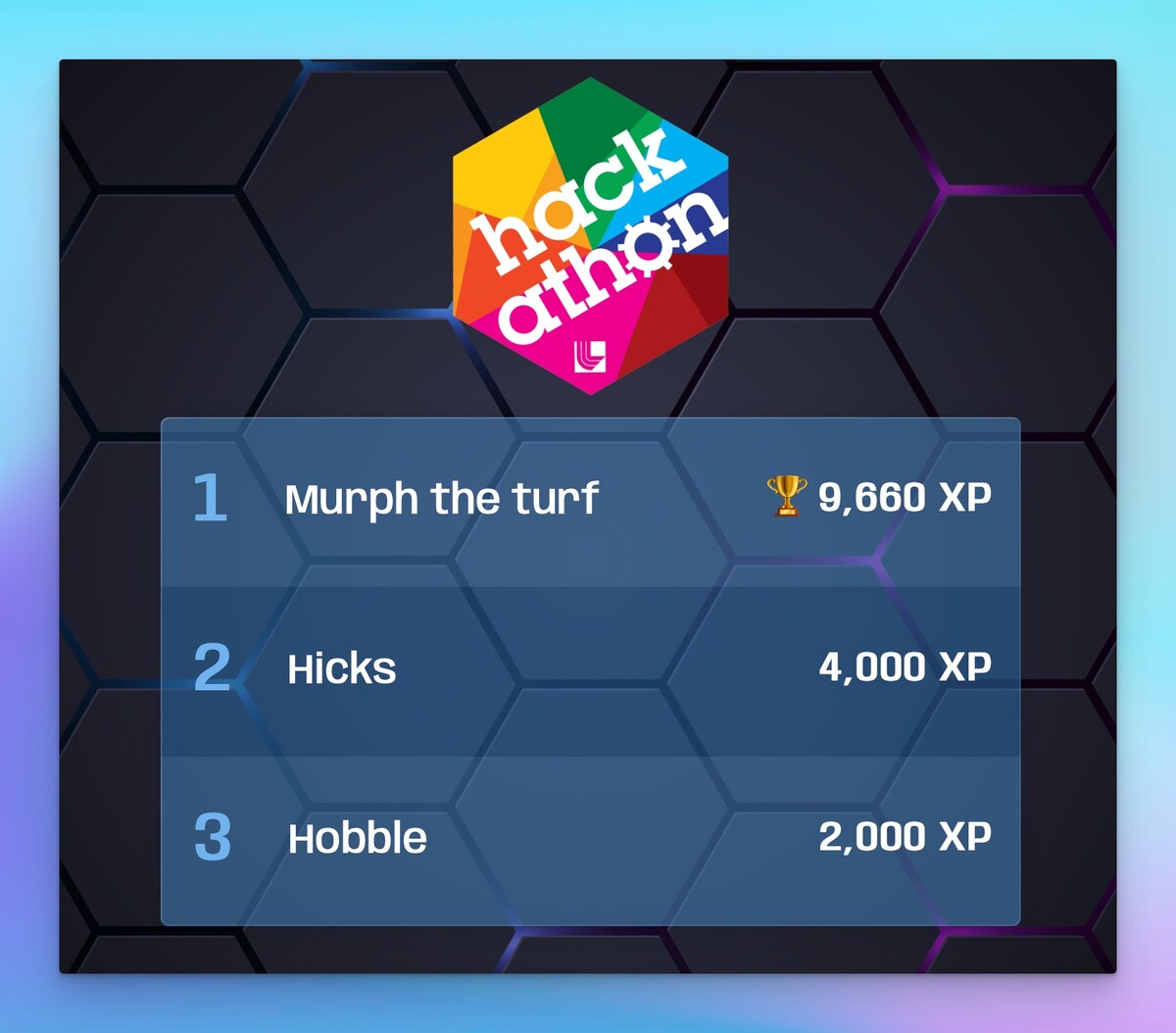
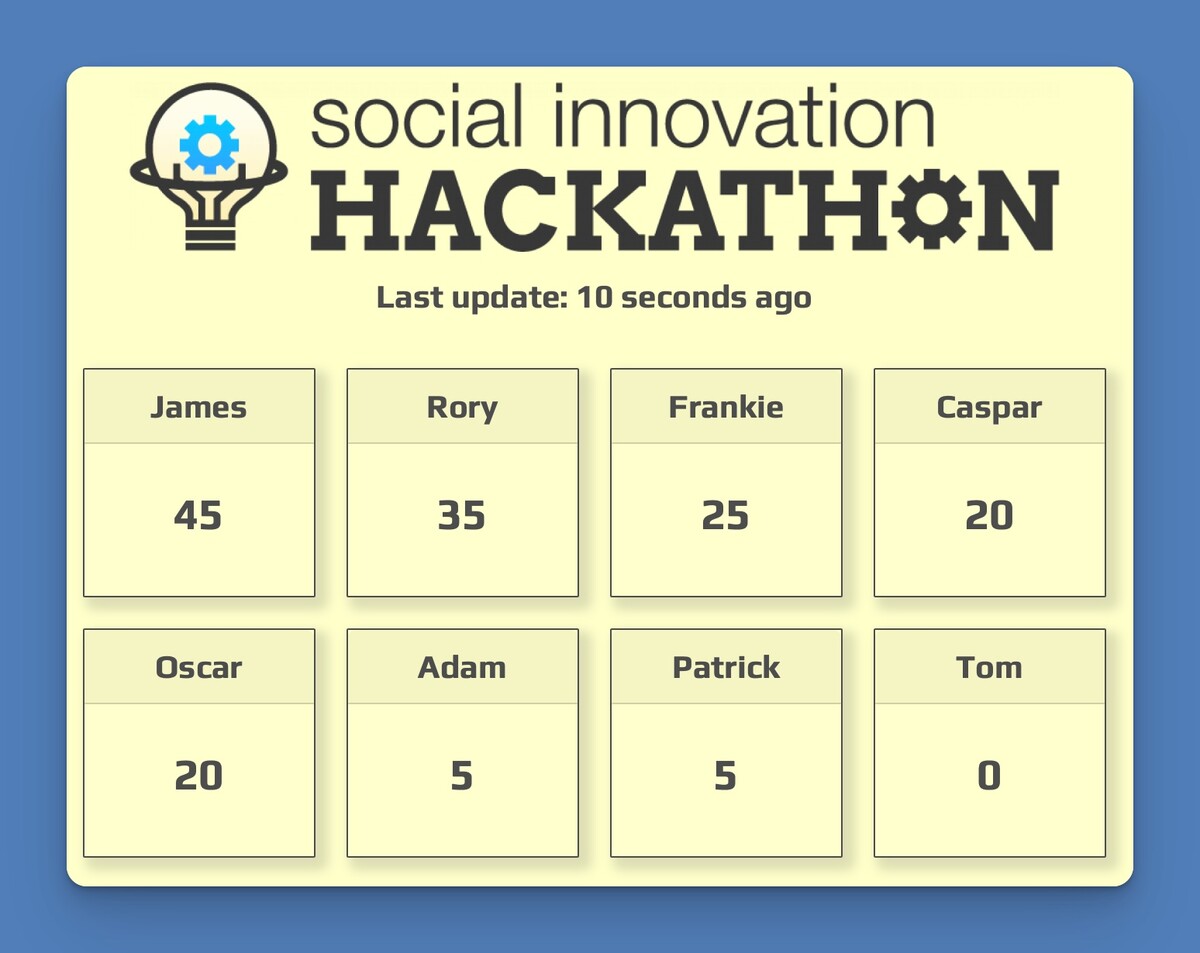
The leaderboard is the spine of the event. It runs on a big screen, updates frequently, and gives every team in the room continuous information about where they stand.
A few design choices matter. Run multiple leaderboards in parallel, not one. An overall points leader is fine, but you also want innovation, collaboration, and people's choice. Every team should be competitive on at least one. If the only thing visible is overall points, the team in tenth at hour twelve is finished mentally even if they have ten hours of work left.
Time the visibility. For the first six hours, hide the standings — early leads create false complacency and trailing teams quit too early. From hours 7-18, show ranks but not exact totals; teams know they're sixth without knowing they're 500 points behind, which keeps motivation up without telling anyone they're hopeless. In the final stretch, show everything: this is when you want maximum information density and maximum stakes.
Freeze the leaderboard with two hours to go. This stops point gaming in the final scramble and pushes teams into completion mode rather than optimisation mode. The freeze creates its own drama — teams calculate furiously to figure out where they probably stand, which is more engaging than knowing exactly where they stand.
Hour by Hour
Pre-event. Pick a platform. Leaderboarded for clean visual leaderboards. DevPost for end-to-end hackathon management. A Google Sheet for zero budget. The broader gamification tools comparison goes through more options. Define point categories, design 20-30 badges, and write the rules clearly enough that teams can understand them in the kickoff. If anything is ambiguous, it'll generate disputes during the event when nobody has time for them.
Hour 0. Ten minutes on gamification — any longer and people zone out. Reference cards on every table. Leaderboard URL announced and visible everywhere. Award an "early bird" badge to everyone present, which starts the point flow before anyone's written a line of code.
Hours 1-6. Points for team formation and first commits. The leaderboard accumulates scores but stays hidden. Teams know points matter, they just don't yet know where they sit. Mentor consultations earn points and badges, which keeps mentors engaged and gives teams a reason to use them.
Hours 7-12. Reveal positions (not totals). This is the event's first energy spike — teams find out they're closer to the lead than they feared, or further behind than they hoped. Either is motivating. Technical badges start flowing for shipped features. The hour-12 prototype checkpoint separates the teams who are building from the teams who are still designing.
Hours 13-18. Full transparency on totals. Teams can now make strategic decisions — go for an innovation badge, push the documentation, target a collaboration bonus. Power hours with multiplied points create scheduled energy bursts. Persistence badges for teams still coding at 3am acknowledge the grind.
Hours 19-24. Leaderboard freezes at hour 22. Teams can't see live competitor progress, which adds uncertainty and keeps effort high. Completion-focused points ensure teams ship rather than perfect. Final submission bonuses reward making the deadline, exhausted or not.
Post-event. Display the final leaderboard. Award badges. Share statistics. Send certificates. These follow-ups are not ceremony — they're the part of the event participants take home, and they determine whether people sign up for the next one.
Surprise Challenges
Drop these during energy lows. They give struggling teams comeback paths and stop the "we're too far behind to care" effect.
A bonus points window for teams that ship a sustainability feature in the next 30 minutes, first five teams only. A larger reward an hour later for accessibility compliance, with a one-hour window and unlimited teams. A documentation derby in the final stretch with a winner-takes-all bonus for the best README. Scarcity creates urgency. Time-boxed creates focus. Both are tools for keeping the room awake during the hours where it would otherwise drift.
Mentors and Sponsors
Mentors disappear at 1am because they have nothing keeping them there. Give them their own game. Points for consultations provided. A mentor leaderboard. Badges for expertise areas. Recognition tied to teams they helped that ended up performing well. A mentor who knows their availability is being tracked tends to stay around.
Sponsors integrate the same way. Sponsor-specific challenges, branded badges for using sponsor APIs, bonus points for the integrations that matter to them. This makes sponsorship feel like part of the event rather than advertising tacked on, which is better for the sponsor and better for the participants.
What Goes Wrong
Point inflation. Teams gaming the system rather than building. Cap points per category. Require evidence for claims. Add quality multipliers so a half-finished feature doesn't score the same as a working one.
Leaderboard obsession. Teams checking rankings every five minutes instead of writing code. Hide exact differentials. Rotate which categories are visible at any moment. Encourage badge diversity over pure point chasing.
Complexity overwhelm. Rules so complicated that nobody reads them and teams end up confused. Start simple. Document with visuals where possible. Automate scoring so teams don't need to track their own points.
Technical failure. Leaderboard crashes mid-event. Have a backup. A Google Sheet running in parallel. Multiple admins with access. Regular exports. The contingency plan exists before the event, not when something breaks at 2am.
Tech Stack
Zero budget: Google Sheets, Google Sites, Google Forms. Functional and reliable, just plain.
Modest budget: Leaderboarded for the public leaderboard, Slack or Discord for live updates, Typeform for submissions, Zapier to glue them together. This gets you a professional-looking event for not much money.
Larger budget: DevPost or a fully integrated platform. Submission handling, automated scoring, real-time updates, mobile views. More setup, more capability.
How You Know It Worked
Quantitative signals: completion rate above 80%, average points per team trending positive across years, badge diversity (most teams earned at least three), mentor consultation frequency. Qualitative signals are more telling — teams are still coding at 3am, the energy in the final hour is up not down, non-winners post about their projects on social, registration for next year's event opens strong.
The point isn't to maximise gamification. It's to use enough of it to keep teams engaged and recognised. Too little and you get the standard energy collapse. Too much and the mechanics distract from the building. The right amount is the amount that makes the hackathon feel structured without making it feel like a video game.
Quick Checklist
Before the event: point system defined, 20+ badges designed, leaderboard platform ready, update schedule planned, rules documented. Nice to have: dynamic challenges prepared, mentor gamification, sponsor integrations, physical badge stickers. Day-of: backup tracking system, dedicated admin team, announcement schedule, celebration plan.
Run a hackathon this way and the energy curve looks different. Teams stay in the room past midnight. The middle hours don't sag. Final presentations have full participation. The first-timers come back next year with a friend.
Need a leaderboard for your next hackathon? Leaderboarded handles the visual side cleanly. Free to start.

Written by Caspar von Wrede
Founder of Rise. Building tools that make tournaments effortless — from brackets to round robins.