Picture this: you randomize an 8-team bracket and the draw puts the reigning champion against last year’s runner-up in the very first round. One of the two best teams goes home immediately. The rest of the bracket is a cakewalk for whichever of them survives.
That’s what happens without seeding. And it’s entirely preventable.
What Seeding Actually Does
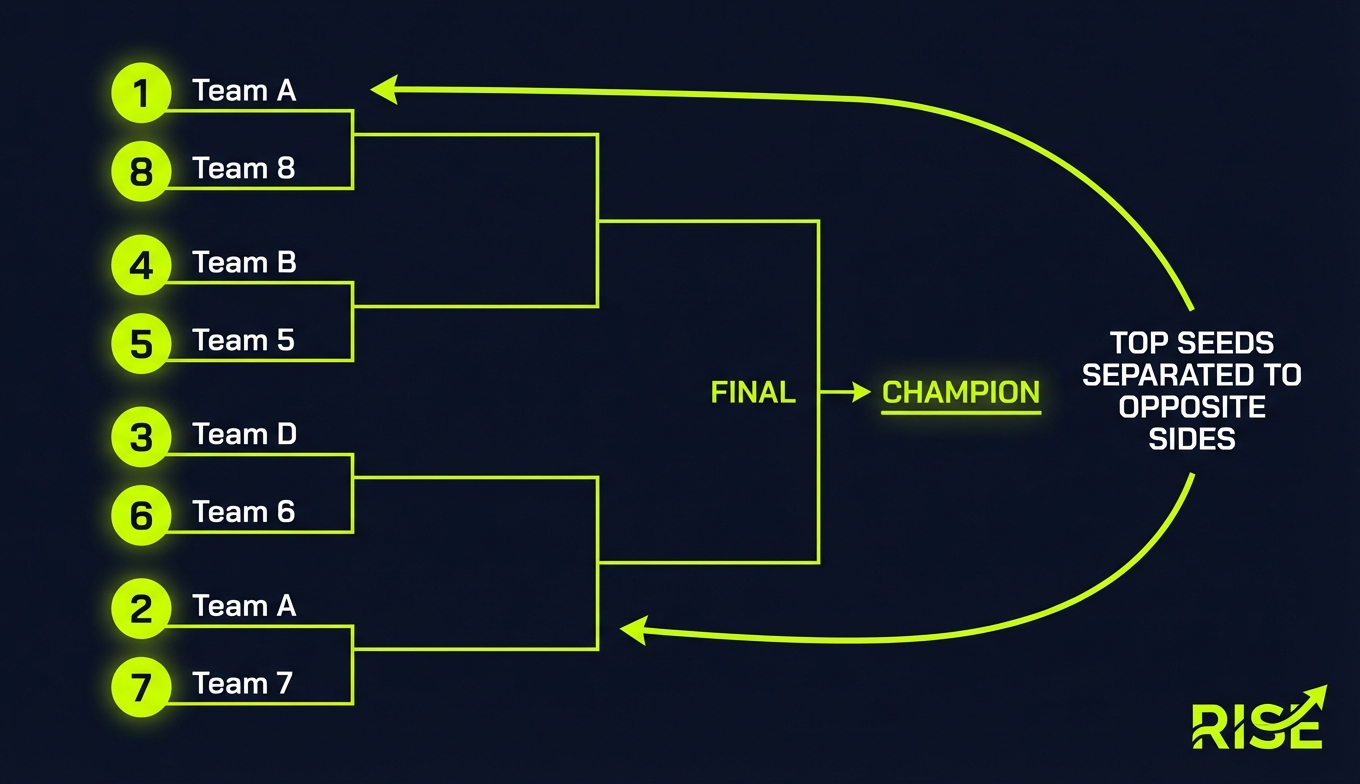
Seeding assigns positions in the bracket based on how good each team is. The best team gets the #1 seed. The worst gets the #8 seed. Then you place them so the strongest teams are as far apart as possible, meaning they can only meet in the later rounds.
In a standard 8-team bracket, the matchups look like this:
- Match 1: #1 seed vs #8 seed
- Match 2: #4 seed vs #5 seed
- Match 3: #2 seed vs #7 seed
- Match 4: #3 seed vs #6 seed
The #1 and #2 seeds are on opposite sides of the bracket. They can’t meet until the final. The #1 and #3 seeds can’t meet until the semifinals. This structure does two things: it rewards being a top seed (you face weaker opponents early), and it protects the bracket from lopsided blowouts that bore everyone.
Why It Matters More Than You Think
Unseeded brackets produce two predictable disasters.
First, blowouts in early rounds. When the best team draws a weak opponent, fine — quick match, move on. But when the #1 and #2 teams collide in round one, you get a thriller that should have been the final, followed by four rounds of the remaining team crushing everyone. Anticlimactic doesn’t begin to cover it.
Second, participant frustration. The #8 team knows they’re the underdog. They’re fine losing in round one to the top seed — that’s expected. But losing to the top seed in round one because of random luck while the #7 team gets an easy draw to the semifinals? That feels unfair. Because it is.
In 16-team brackets and larger, the problem compounds. Without seeding, you might end up with an entire quarter of the bracket loaded with strong teams while another quarter is a free pass to the semis.
How to Determine Seeds
This is where it gets political. Everyone agrees seeding is good. Nobody agrees on how to rank the teams.
By previous results
The most objective method. Use last tournament’s results, league standings, or head-to-head records. Hard to argue with data. Doesn’t work if teams are new or the roster has changed significantly.
By ranking or rating
If your sport has an Elo rating, a national ranking, or any kind of official standing — use it. This is how tennis does it, how chess does it, how most esports do it. Transparent and consistent.
By committee
A panel of organizers or coaches ranks the teams based on whatever information they have. This is how the NCAA basketball selection committee works. It’s also how arguments start. Use this as a last resort, and publish your criteria before you start ranking.
By regular season record
If your bracket is the playoff at the end of a league season, the seeding is already done. Best regular season record gets #1. This is the cleanest approach because the teams seeded themselves through weeks of competition.
A Concrete Example
You’re running an 8-team cornhole tournament. You know the teams from previous events. Here’s your ranking:
- Team “Bags of Glory” — won last two tournaments
- Team “Corn Stars” — consistent top-3 finisher
- Team “Toss Up” — strong but inconsistent
- Team “Board Game” — solid mid-tier
- Team “Sack Attack” — improving, decent recent results
- Team “Hole Lotta Fun” — average
- Team “Kernel Panic” — new team, limited data
- Team “Air Mail” — newest team, no track record
Place them in the bracket: Bags of Glory vs Air Mail, Board Game vs Sack Attack on one side. Corn Stars vs Kernel Panic, Toss Up vs Hole Lotta Fun on the other side.
The projected semifinal? Bags of Glory vs Board Game, Corn Stars vs Toss Up. The projected final? Bags of Glory vs Corn Stars. Your two best teams meeting at the end, not the beginning.
What About Unseeded Brackets?
Random draws have one genuine advantage: they’re perceived as completely fair. No one can complain about bias in the seeding if there was no seeding.
For casual events where competitive integrity doesn’t matter much — an office party tournament, a family reunion bracket, a pub quiz playoff — random is fine. The point is fun, not crowning a legitimate champion.
But the moment you add entry fees, prizes, travel costs, or rankings that carry over to future events, random seeding is disrespectful to your participants. They put in work to earn their position. The bracket should reflect that.
Rise’s bracket generator handles seeding placement automatically. Enter your teams in ranked order and the bracket slots them into the correct positions — no manual placement, no accidentally putting #1 and #2 on the same side. It’s one of those things that sounds simple until you try to do it by hand with 32 or 64 teams.