Most people who join a fitness challenge mean it. They commit on day one, log a couple of workouts in week one, and then quietly disappear. You see the same shape of curve everywhere — gym memberships in January, app installs after New Year’s, corporate wellness sign-ups after the kickoff email.
The thing that bends that curve most reliably isn’t a better app or a more inspiring goal. It’s other people watching. A public leaderboard with your name on it changes the calculation for getting up at 6am, because skipping the workout now means losing ground that someone else will see you lose.
Willpower Doesn’t Scale
Solo motivation works for a small minority of people for a small amount of time. For everyone else it runs out by week three. This isn’t a character flaw, it’s just how willpower works — it’s a limited resource, and once it’s gone you fall back on whatever your defaults are.
Leaderboards work because they substitute social accountability for willpower. You’re not relying on yourself to stay motivated. You’re relying on the fact that ranking 47th out of 50 in front of your colleagues feels worse than going for a walk. There’s also a real dopamine effect — climbing a few places after a good week feels good, and that small hit of satisfaction is enough to nudge you out the door tomorrow.
The combination is what does the work: visibility creates accountability, and ranking changes give you something to chase. Neither is heroic. Both are reliable.
What Kinds of Challenges Work
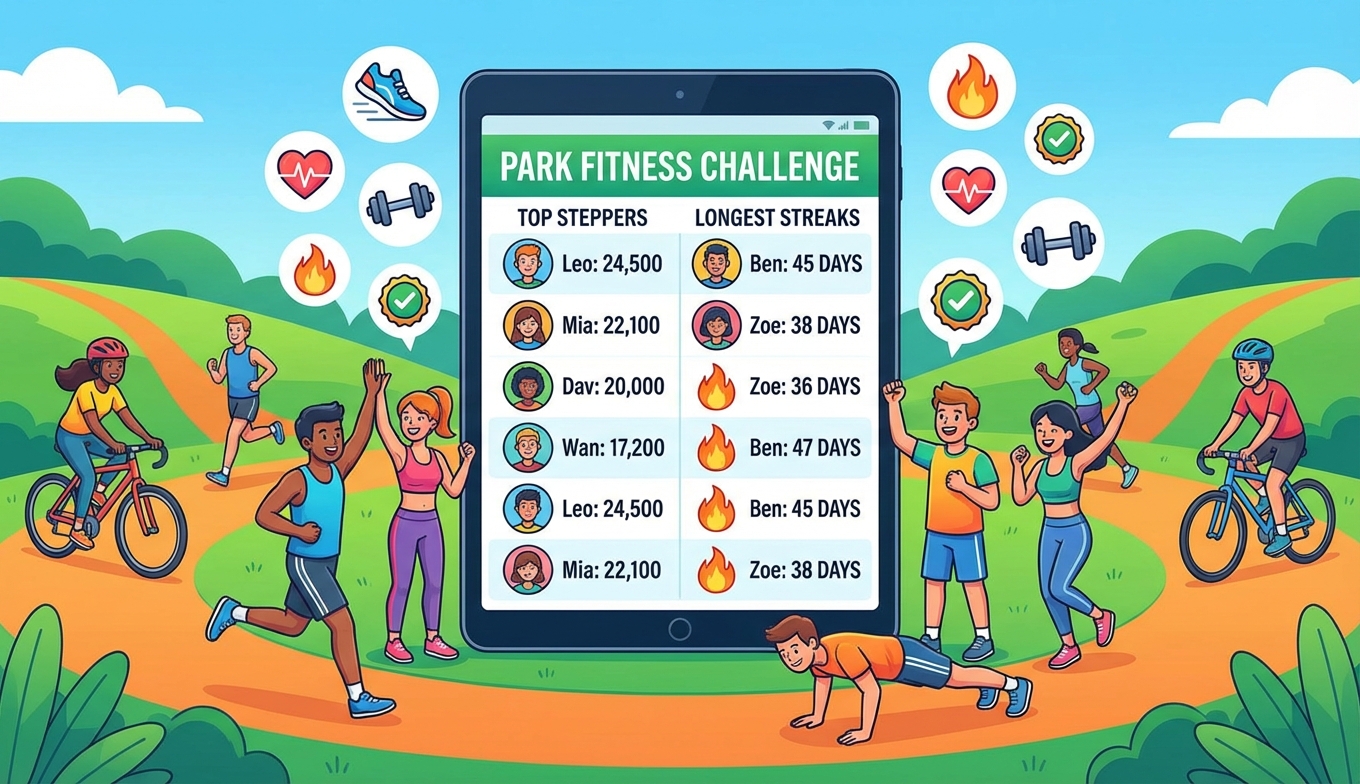
Step challenges are the easiest place to start. Everyone walks. Phones already track it. The barrier to participation is essentially zero, which means you’ll get the broad sign-up rates you need to make a leaderboard interesting. Add a narrative — “we’re walking from London to Edinburgh as a team” — and the steps stop feeling like a chore and start feeling like a journey with a destination.
Workout count challenges work when your group already has some baseline of activity. Track number of sessions per week, regardless of intensity. This rewards consistency over performance, which is what most people actually need to build a habit anyway.
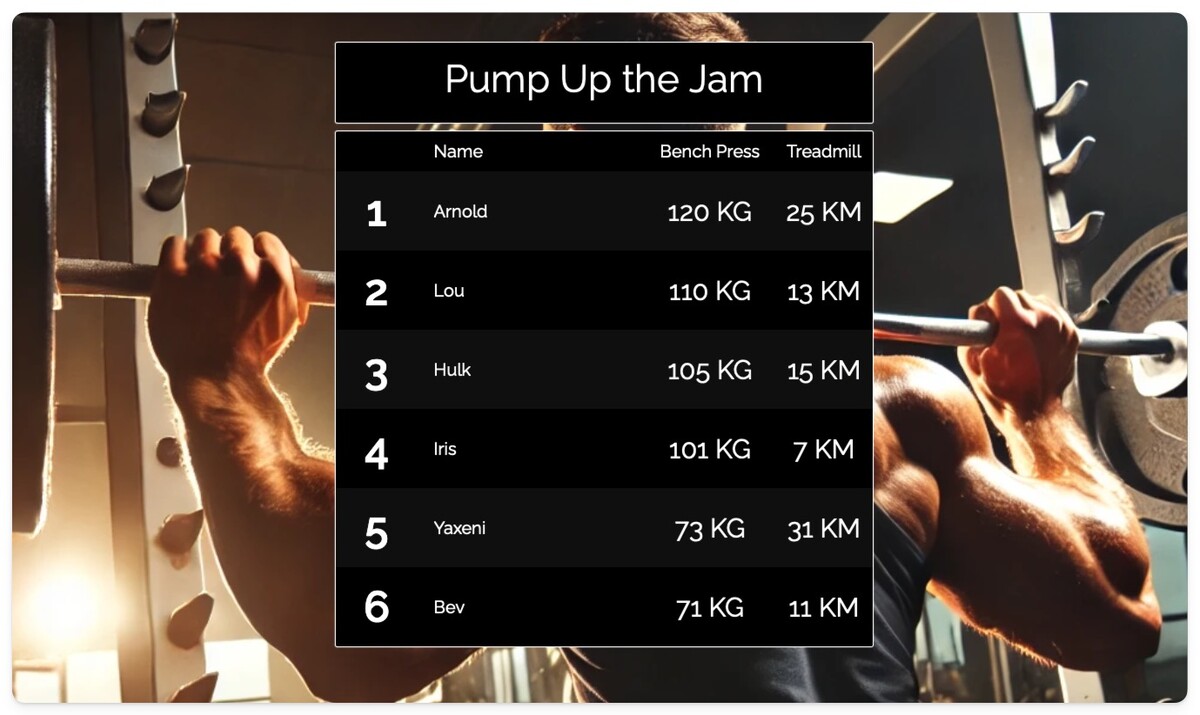
Strength or PR challenges are great for groups that lift. The leaderboard tracks personal records, total volume lifted, or improvement over a baseline. The shift from “how do I look” to “what can I do” is healthier and more motivating for most people.
Weight loss challenges are the riskiest format. They can encourage unhealthy behaviour and they punish people whose bodies don’t respond on the same timeline. If you run one, score by percentage rather than absolute pounds, include non-scale outcomes like consistency and energy, and require medical clearance for anyone with conditions that make it complicated. Better still, run a behaviour challenge — workouts logged, water tracked, sleep recorded — and let weight loss happen as a side effect.

Why Public Beats Private
Strava knew this. Peloton knew this. The reason their products got addictive wasn’t the equipment. It was the leaderboard. Riding alone in your garage at 6am stops feeling lonely the moment you can see fifty other people doing the same class and your name is among them.
The same principle works at smaller scale. A workplace step challenge with a leaderboard on a Slack channel produces dramatically more activity than a step challenge where everyone just tracks privately. The reasons are mostly about the psychology of competition — public commitment creates pressure to follow through, and small rank changes give you continuous feedback that solo tracking can’t match.
There’s a corporate version of this too. Microsoft’s global step challenges have run with tens of thousands of employees across dozens of countries, and average daily steps reliably climb during the challenge window. It’s the same mechanic, just at scale. For more on this kind of programme, our piece on corporate gamification covers what works inside larger organisations.
Running One Yourself
You don’t need a platform budget or an HR team. Here’s what matters.
Pick one metric and one duration. Steps for 30 days. Workouts logged for four weeks. One thing you can measure cleanly. Mixed-metric challenges with custom point conversions sound clever and end up confusing everyone in week one.
Write the rules clearly before you launch. How are points earned? What activities count? Honor system or do people upload screenshots? Get this in writing and pinned somewhere people can find it, because every ambiguity will turn into an argument and every argument will cost you participants.
Recruit the keen people first. Five enthusiastic participants will do more for momentum than fifty lukewarm ones. The skeptics watch what happens for a week or two and then decide whether to join. Trying to convince them up front is wasted energy.
Set up a communication channel. Slack, WhatsApp, whatever the group already uses. The trash talk and encouragement matter as much as the leaderboard itself. People drop out of challenges that feel like spreadsheets. They stick with challenges that feel like a group thing.
For tracking, pick something that matches the metric. Strava handles running and cycling. Fitbit and Apple Health do steps natively. Leaderboarded works well if you want a clean visual leaderboard for an office screen or shared dashboard. A Google Sheet works if you want free and don’t mind manual entry.

Where Challenges Fall Apart
The most common failure is intimidation. The first leaderboard goes up, three serious athletes are at the top by week one, and everyone else decides not to bother. You can prevent this with separate leagues by fitness level, or by giving “most improved” the same visibility as “most active.” When the highlight on Friday is the colleague who went from zero to five workouts, not the one who already did ten, the message is that everyone has a path.
The second failure is honesty. People inflate. The fix is automatic tracking wherever possible — pulling steps directly from a fitness tracker rather than self-reporting — and making the rewards about belonging rather than prizes. Cheating for a $20 gift card is a real problem. Cheating for “being on the leaderboard with your colleagues” mostly isn’t, because the reward is intrinsic to the participation.
The third failure is dropoff. Initial enthusiasm fades around day eight. Shorter challenge windows (two to four weeks) help. Mid-challenge resets help. Team formats with paired accountability help. The biggest single factor is whether people feel connected to other participants or just to a tracker.
The fourth is injury. Overenthusiastic participants doing too much too fast. Cap daily points so there’s no benefit to walking 30,000 steps in a day. Build in mandatory rest days. Reward recovery activities — yoga sessions, stretching, sleep — alongside the harder stuff. A challenge that sends people to physiotherapy isn’t a successful challenge.
After the Challenge
A leaderboard motivates from the outside. Lasting fitness habits come from the inside, and the bridge between the two is identity. The goal of running a challenge isn’t to keep people checking the leaderboard forever — it’s to get enough reps in during the challenge window that they start thinking of themselves as someone who exercises, and then the leaderboard becomes optional.
This is why the strongest challenges focus on consistency and visible improvement rather than absolute performance. By the end of week four, the participant has accumulated evidence that they can do this, and that evidence is what survives after the challenge ends. The leaderboard did its job by getting them to that point.
The interesting moment in any challenge is the day someone stops checking the leaderboard out of obligation and starts checking it out of curiosity. They’ve already worked out. They just want to see whether they moved up. That’s the shift you’re trying to engineer.
If you want a fitness leaderboard for an office screen, gym, or community group, Leaderboarded handles the visuals. Free to start.