What Is Single Elimination? How the Most Common Tournament Format Works
Single elimination is the simplest, most dramatic tournament format — one loss and you're out. How it works, when to use it, and why it still dominates.
Article Contents
Lose once and you're done.
That's the whole idea behind single elimination. Every match is a must-win. There is no second chance, no consolation path, no way back in once you've dropped a game. It's the format March Madness runs on. Fighting game majors use it. So do high school sports playoffs and pub trivia finals. If you've ever filled out a bracket on the back of a printout, you were doing single elimination.
This post walks through how the format works, when it's the right choice, and where it falls short.
How It Works
You take all your teams, place them into a bracket, and play through it round by round. Round one, every team plays. The winners advance, the losers go home. Round two, the surviving half plays. Half of those survive. You keep halving the field until one team is left, and that team is the champion.
The match count is the same arithmetic every time: total matches equals total teams minus one. Eight teams means seven matches. Sixteen teams, fifteen matches. Thirty-two teams, thirty-one. Each match eliminates one team, and you need to eliminate everyone except the winner.
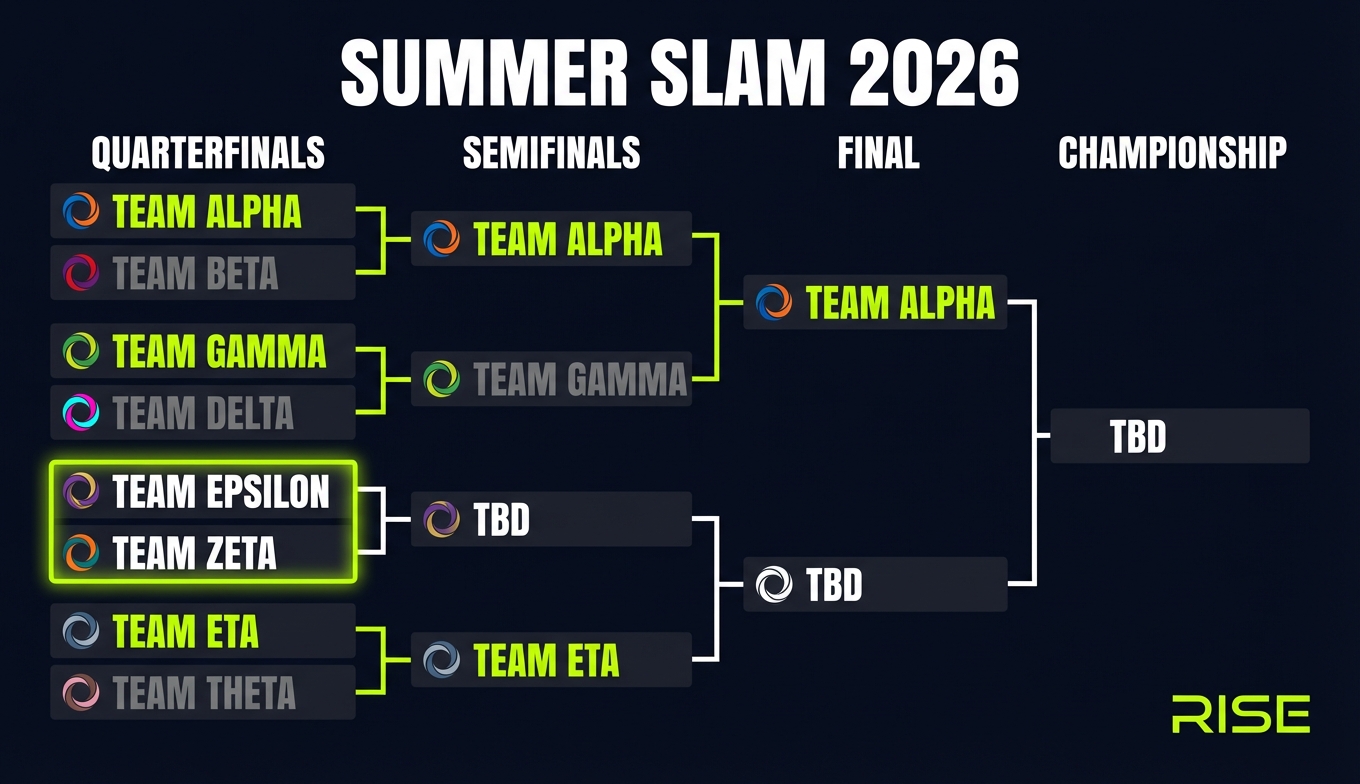
Visualised, the bracket is a tree. Teams sit at the leaves. The champion comes out of the root. Round one is the widest, with the most matches happening at once. The final is a single match.
Byes — the term for a free pass into the next round when a team isn't paired against anyone — show up when your team count isn't a clean power of two. A 12-team bracket needs four byes in round one to get the field down to eight before round two. Higher seeds usually get them.
A Walk-Through With 8 Teams
Eight teams, three rounds, seven matches.
Quarterfinals. Four matches at once. With proper seeding, the matchups are #1 vs #8, #2 vs #7, #3 vs #6, #4 vs #5. Four teams advance.
Semifinals. The four winners play two matches. Two advance.
Final. One match. One champion.
That's it. The whole tournament can wrap in an afternoon with a couple of courts.
What It's Good At, What It Isn't
Single elimination has clear strengths and clear weaknesses, and which one matters more depends on what your event needs.
Speed is the obvious advantage. With 16 teams, you're done in 15 matches across four rounds. Round robin at 16 teams takes 120 matches. Double elimination takes about 30. Single elimination scales better than any other format when you're working with limited time, limited courts, or a large field.
Drama is the second strength. Every match carries weight. A first-round upset has stakes that a group-stage upset doesn't. A team running the bracket from start to finish has a story arc you can follow. The format itself becomes a cultural artifact — the printed bracket on the office fridge during March Madness exists because single elimination produces moments that are easy to follow even if you don't follow the sport.
Fairness is the trade-off. One bad day, one unlucky draw, one off match, and a strong team is out. The format is better at producing exciting outcomes than at identifying the genuinely best team in the field. A team that loses to the eventual champion in the first round might be the second-best team in the tournament — they'll never get to prove it. Round robin's full schedule and double elimination's losers bracket both correct for this. Single elimination doesn't.
Bracket variance is the related problem. Bad seeding can put two strong teams on the same side of the bracket, which means one of them goes out early and the other side has an easier path to the final. Good seeding mitigates this but doesn't eliminate it.
Compared to Other Formats
The three main formats sit on a spectrum from fast and brutal to slow and fair.
Single elimination is the fastest, the least forgiving, and the easiest to run logistically. Use it when there are too many teams to do anything else, or when speed and drama are the point.
Double elimination adds a losers bracket. A team that loses once can still work their way to the title through the lower bracket. It takes roughly twice as many matches as single elimination, but the result is meaningfully fairer. Competitive gaming, cornhole, and most serious tournament scenes use it as the default. The price is time.
Round robin has every team play every other team. It's the fairest format on offer because no single result can knock out a strong team. The trade-off is match count, which makes it impractical for fields larger than about eight teams unless the entire event is built around it (a sports league season, for example, is essentially a round robin).
A hybrid is often the right answer. Group stage round robin to give every team multiple matches and produce meaningful seedings, then a single-elimination knockout to drive toward a champion. Most major sports tournaments use a version of this.
When Single Elimination Is Right
Use it when speed matters more than perfect fairness. Large fields — 32, 64, 128 teams — almost always run single elimination because no other format scales. March Madness has 68 teams. A double-elimination bracket of that size in three weeks isn't possible.
Use it when the event is partly about entertainment. Charity tournaments, office bracket challenges, casual gaming nights. Single elimination produces more memorable moments per hour than any other format. Upsets feel like upsets. Champions feel earned.
Don't use it when participants have travelled or invested significant resources to compete. The player who flew across the country and lost in the first round will leave bitter, and they're not wrong to. In contexts like that, double elimination is almost always the right call. The extra time is worth it.
Seeding
Single elimination without seeding produces chaos. The two best teams might draw each other in round one. One of them goes home before they've had a chance to face anyone else, and the bracket loses a finalist.
The standard fix: rank everyone, then place them so the top seeds can only meet in late rounds. #1 in one quarter of the bracket, #2 in the opposite quarter, #3 and #4 split between the other two. This pushes the strong-vs-strong matchups toward the later rounds where they belong.
If you don't have reliable seedings, use whatever ranking you do have. Prior tournament results. Regular season records. Coach assessments. Even a random draw beats unseeded chaos. An imperfect seed is better than no seed at all.
Running the Bracket
A paper bracket works fine for eight teams. Sixteen teams gets messy. Thirty-two teams without a digital tool is a part-time job — keeping participants informed about their next match, updating the bracket between rounds, fielding the same "when do we play next?" question over and over.
This is the problem Rise is built for. Brackets update live, participants check their schedule and next match on their phones, and a shared display stays current without anyone redrawing anything between rounds.
Join the waitlist to be first in when we launch.
FAQ
How many matches does single elimination take? Total teams minus one. 8 teams = 7 matches. 16 teams = 15 matches. 32 teams = 31 matches. The pattern doesn't change.
What if I don't have a power-of-two number of teams? You add byes. With 10 teams, two of them get a free pass through round one, leaving 8 teams to play out a standard bracket from there. Higher seeds usually get the byes.
Is single elimination fair? It's the least fair of the major formats in the sense that one match can decide everything. The best team doesn't always win. That same unpredictability is part of why it's exciting to play and watch.
Should I use single or double elimination? Single if time is tight or the field is large. Double if participants have made a real investment to be there and care about the result. Round robin if the field is small and everyone wants maximum playing time.
Can I combine formats? Yes, and it's common. Group stage round robin followed by a knockout bracket is the standard hybrid in most major sports tournaments. Teams get guaranteed matches in the group phase, then advance into a traditional single-elimination bracket.

Written by Caspar von Wrede
Founder of Rise. Building tools that make tournaments effortless — from brackets to round robins.